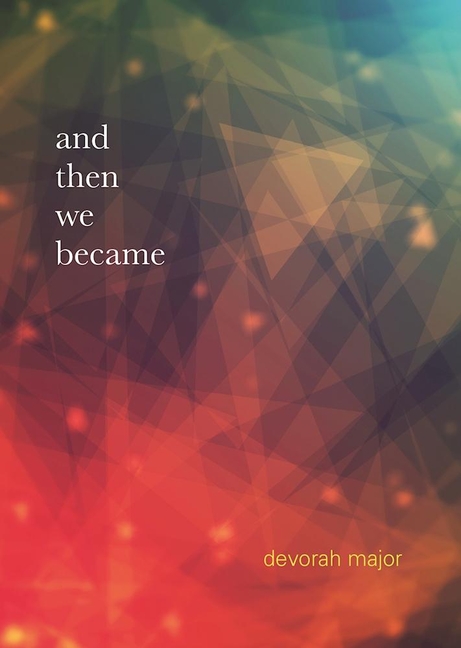
"major's poetry moves from San Francisco's Mission Street and the Tenderloin (she's a former San Francisco poet laureate) to Africa, and from there to the far reaches of the universe. It conjures ancestors, honors memories of mothers, daughters and sisters, and traces births, beginnings and the origins of all things, including language and poetry itself, which major frames as a shield, a sword and as a healing salve. ... If readers aren't sure if they're meant to belong to major's tribe, they likely will feel that this spellbinding, all-inclusive, all-embracing book initiates them. 'year of the dragon, ' the third poem in the volume, might be the chant and hymn for 2016, as when major writes, 'it's an abstract constellation we live in / knowing the clock will turn / at any moment.' Many of the individual poems in and then we became stand a good chance of becoming 'news that stays news, ' to borrow the catchy phrase that the modernist poet Ezra Pound used to describe poetry itself."-San Francisco Chronicle
"Four sections of this long-awaited volume: 'spirit', 'other selves', 'fragile', 'whole' reveal a writer and life experiencer at the height of her poetic powers. Whenever I become too self-satisfied in intellectual games, I find my heart upended by these impassioned verses of humanity and what it means to be fully alive and present. From 'nommo-how we come to speak' to 'war memories', this former San Francisco Poet Laureate and worldly cosmonaut handles politics, war, and love in equal measure as the best poets of the people do. Pablo Neruda. Bob Kaufman, June Jordan. Wanda Coleman. Ears to the ground and eyes to the sky."-Giovanni Singleton
"A narrative poet of witness and resistance, devorah major writes of a dystopian, but not fictive past, naming ancestral worlds as the parallel universe in which she lives. Her poems take place in Yoruba and Haiti, but also in Newtown, in emergency rooms, in a homeless man's despair, in a lover's bed. The poet/speaker may counter grief with spirituality, the cosmos, and hope, may observe 'how suffer and celebration/could sleep so close together, ' yet she unsentimentally challenges the willful refusal to see, to listen, to act. In lines no longer than a heartbeat, a breath, she takes on Gwendolyn Brooks' promise to be a poet of community, accessibility, and love. There are echoes of Harriet Tubman, and guerrilla survival, Richard Wright and his 'hidden/underground, ' Adrienne Rich and the mistranslations and mangling of language, Toni Morrison's night-riding horsemen, the 'new species of black birds/who would not be silenced/and could not be killed.' They, too, are ancestors, guiding the speaker to that most personal of transformations: the journey of 'becoming, ' literally embodied as the last word of the final poem in this collection."-Lynda Koolish, author and photographer of African American Writers: Portraits and Visions
"A granddaughter of immigrants, San Francisco's third poet laureate, and winner of honors from PEN Oakland and the Black Caucus of the American Library Association, major wields language vibrantly yet shows how it can be used against the marginalized: 'we honor speech// that can make us hate/ that can cause us to deny/ our mothers/ our brothers/ our self.' Yet she stands defiant. 'I did/ ask to be born, ' she proclaims, elsewhere asserting 'we come to this city/ and we name it ours.' Not surprisingly, an especially strong section asserting a feminist perspective through stories (in particular, see 'amina's trial') is titled 'and then we became other selves.' A fine spiritual and political reckoning for most readers."-Library Journal
"major ... favors rich language and punchy lines as she ponders her place in the universe, and her relation to others similarly making their way. She captures emotions with economical precision, a trait that is evident in such po