



City Lights with the Center for the Art of Translation/Two Lines present
Jay Boss Rubin and Annmarie Drury
celebrating the publication of
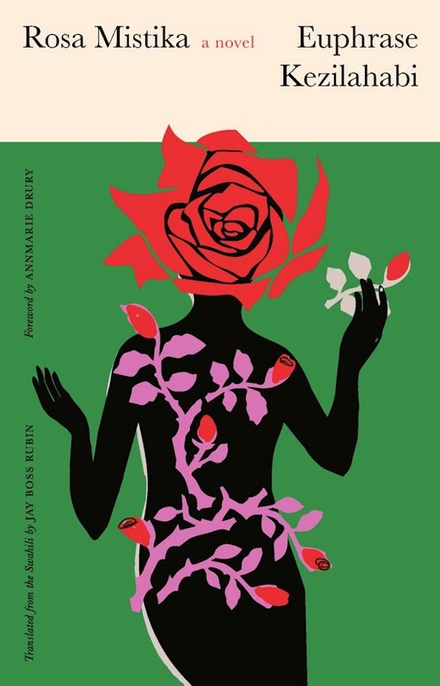
Rosa Mistika
By Euphrase Kezilahabi
Published by Yale University Press
Translated by Jay Boss Rubin – Foreword by Annmarie Drury
A controversial Swahili classic by one of Tanzania’s most revered writers, banned on publication and finally translated into English
A New Yorker Best of the Week Pick
About ROSA MISTIKA
Teenage Rosa lives with her parents and four younger sisters in a village on Ukerewe Island in Lake Victoria, where she attends the local school and helps out on the family farm. Life would be relatively peaceful if it weren’t for Rosa’s father, who drinks to oblivion and abuses his wife and daughters. Initially relieved to be admitted into a residential school on the mainland, Rosa soon discovers that she’s ill prepared for life outside her village. As she becomes accustomed to the attention—and manipulations—of men, she begins to understand her sexuality as a weapon. But this understanding, born of the need to survive in a world of double standards, comes with a price.
Rosa Mistika is a radical narrative exploration of womanhood, maternal love, agency, and authority—and the first-ever Swahili novel to address issues of domestic violence, sexual coercion, and abortion. Through the story of a young woman and her community it poses the enduring question: To what degree are we responsible for the choices we make, and to what degree are we acted upon by forces outside our control?
Euphrase Kezilahabi (1944–2020) was a Tanzanian novelist, poet, and scholar.
Jay Boss Rubin is an award-winning translator of Swahili works.
Annmarie Drury is professor of English at Queens College, City University of New York.
Praise for Rosa Mistika
“Originally written in 1971, Kezilahabi’s novel of changing cultural attitudes in Tanzania, particularly toward female sexuality, was at first banned, before becoming a classic. . . . Playing in the space between social realism and fabulist storytelling, [the] novel asks moral questions about parents’ responsibilities and the effects of women’s liberation, sparing no one but withholding final judgment.”—New Yorker
A New Yorker Best of the Week Pick
“Engaging . . . a packed and quick-moving novel.”—M. A. Orthofer, Complete Review
“A novel about a young woman facing the hypocrisies and hazards of her society. . . . A social novel that occasionally ventures into more stylized territory.”—Tobias Carroll, Words Without Borders
“A tremendously important novel.”—Abdulrazak Gurnah, winner of the 2021 Nobel Prize for Literature
“Carefully and beautifully translated, Rosa Mistika is a profound meditation on how we come to independence as individuals, as women and men steeped in patriarchy, and in societies still wearing neocolonial rags—and then when tasked with freedom, what we do with it.”—Mũkoma wa Ngũgĩ, author of The Rise of the African Novel: Politics of Identity, Language and Ownership
“First banned, Euphrase Kezilahabi’s wonderful novel Rosa Mistika is now required reading. Neither fool nor victim, plucky Rosa discovers boys in this wild yet very believable tale, but it doesn’t go well. She must struggle hard to dodge the obstacles of father, double standards, desire, and motherhood. Bringing Tanzanian mores to life for innocent readers everywhere, Rosa Mistika will become a classic for women all over the world.”—Teresa Svoboda, winner of the Graywolf Nonfiction Prize and the translator of Cleaned the Crocodile’s Teeth: Nuer Song
“Thanks to Jay Boss Rubin, Euphrase Kezilahabi’s powerful first novel, Rosa Mistika, finds its way into English at long last. For its sympathetic focus on the plight of women and girls in Tanzania, the novel is as relevant today as it was when first published in 1971.”—Jeffery Renard Allen, author of Fat Time and Other Stories and Song of the Shank
“This cutting-edge translation of a book that has continuously stirred the Swahili literary scene gives us access to a world and contradictions that are rarely available in the West, at a time when we question what is translated, how, and why.”—Ida Hadjivayanis, SOAS, University of London
“In Jay Boss Rubin’s excellent rendering, I felt like I was reading Rosa Mistika in Swahili again, but also like I was reading the book for the first time. There are two languages here, not just one in place of another. A remarkable work of translation.”—Idza Luhumyo, winner of the 2022 AKO Caine Prize for African Writing

The Center for the Art of Translation, a 501(c)(3) nonprofit organization based in San Francisco, was founded in 2000 by Olivia Sears, an Italian translator and editor who serves as the Center’s board president. In 1993, prior to forming the Center, Sears helped to establish the literary translation journal Two Lines: World Writing in Translation at a time when there were very few venues for translated literature in English, and those handful rarely paid much attention to the translator beyond a brief acknowledgment. Two Lines set out to challenge that trend—to make international literature more accessible to English-speaking audiences, to champion the unsung work of translators, and to create a forum for translators to discuss their craft. In this way, Two Lines serves as the Center’s cornerstone, and the journal’s spirit radiates through all of the Center’s work today.
Made possible by support from the City Lights Foundation.